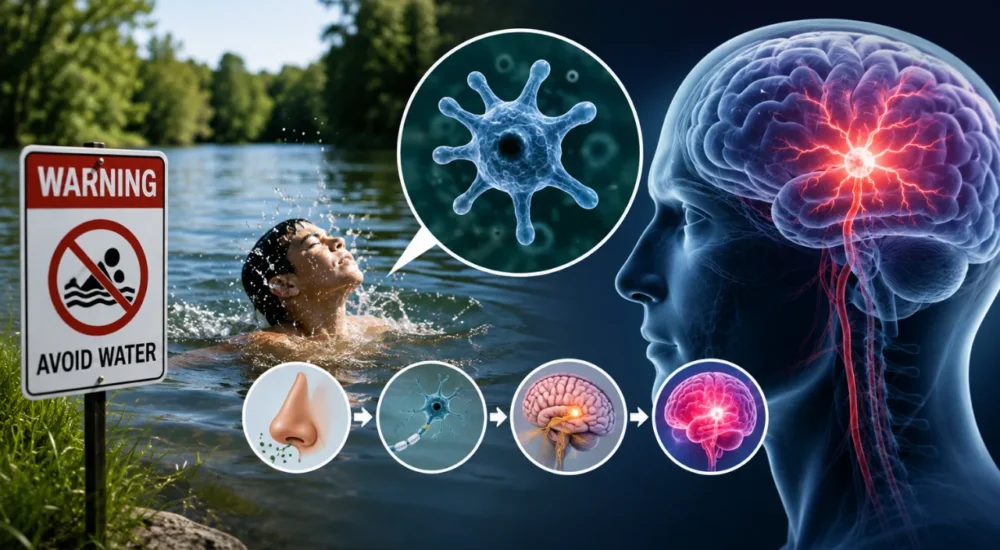
BATON ROUGE, LA — Louisiana health officials have confirmed a rare Naegleria fowleri infection in a resident who most likely picked it up after swimming in Lake Claiborne. The parasite, often called the brain eating amoeba, is known to cause a fast moving and usually deadly illness when contaminated water enters the nose.
The Louisiana Department of Health said this week that the case is only the fourth documented Naegleria fowleri infection in the state since 1937. Officials also used the announcement to remind people that the risk rises in warm freshwater, especially during the summer when the organism is more likely to be present.
What Health Officials Said
The department said the infection was confirmed after the resident’s likely exposure in northern Louisiana. It warned recreational water users not to assume warm freshwater is harmless, even though the overall chance of infection remains low.
Health officials described the illness as primary amebic meningoencephalitis, or PAM, and said it can progress quickly after infection. The CDC has recorded 180 PAM cases in the United States from 1937 through 2025, with most cases reported in July and August.
How The Infection Happens
Naegleria fowleri lives naturally in warm freshwater lakes, ponds, rivers, some hot springs and other warm water environments. The amoeba does not cause infection from simply drinking water, and it does not spread from person to person.
The danger comes when water containing the amoeba goes up the nose. From there, it can travel along the nerves that connect the nose to the brain and cause inflammation and destruction of brain tissue. According to CDC data, symptoms generally begin within one to 12 days after exposure.
What To Watch Next
The Louisiana Department of Health said people can lower exposure by keeping water out of the nose, including by using nose clips or keeping the head above water while swimming in warm freshwater. The CDC also advises avoiding activities in warm freshwater when possible during periods of high water temperature.
For nasal rinsing, the CDC recommends using distilled or sterile water, or tap water that has been boiled and cooled. The agency also says people should avoid stirring up sediment in shallow, warm areas, where the amoeba can be present.
More on health, care, money and the people nearby, on Westlake Arrow.